
Vespa Scooters Service Station Manuals, Wiring Diagrams PDF
46 manuals
Manuals (35)
Vespa Codici Colore
- 445.4kb
Vespa Engine Guide
- 2.6Mb
Vespa ET2 ET4 Technical Manual
- 958.2kb
Vespa ET4 Workshop Manual
- 28.7Mb
Vespa G.S Service Repair Manual
- 2.6Mb
Vespa G.S Service Station Manual
- 9.6Mb
Vespa GTS 250 Service Repair Manual
- RAR
- 32.5Mb
Vespa GTS125 Workshop Manual
- 18.1Mb
Vespa GTS250 Workshop Manual
- 26.6Mb
Vespa GTS300 Super Workshop Manual
- 22.3Mb
Vespa LX 50 Workshop Manual
- 5.6Mb
Vespa PX 150 Workshop Manual
- 5.8Mb
Vespa Scooter Catalog
- 45.5Mb
Vespa Tipi e Numerazione Telai
- 460.7kb
Vespa Vintage Catalogo
- 10.9Mb
Vespa Scooters Wiring Diagrams (11)
Vespa Electrical Troubleshooting
- DOCX
- 919.6kb
Vespa Et4 Wiring Diagram
- 3Mb
Vespa GT125 Euro3 Wiring Diagram
- 608.2kb
Vespa GTS125 Wiring Diagram
- 619.2kb
Vespa GTS250 ABS Wiring Diagram
- 3.8Mb
Vespa GTV250 Wiring Diagram
- 1.3Mb
Vespa LX125-150ie Wiring Diagram
- 1.1Mb
Vespa LX50 4Valve Wiring Diagram
- 629.9kb
Vespa Wiring Diagrams 1964 - 1973
- 16.2kb
Vespa is a cult Italian scooter. It has been produced by Piaggio from April 1946 until now. It is the founder of the European design school of scooters and the first successful scooter in the world.
Vespa was designed by Corradino D’Ascanio, an aeronautical engineer, commissioned by Enrico Piaggio. The car was designed from scratch without regard to traditional motorcycles. It was based on other aviation principles. Namely: the combination of functions and the rejection of all superfluous. A characteristic feature of this model is a frameless design. The role of the frame was played by the supporting body, whose simple stamped panels were connected by spot welding. An engine with a horizontal cylinder (working volume of 91 cm³, power 3.3 hp at 4,500 rpm) was blocked with a three-speed gearbox, the gears were switched by a rotating handle on the steering wheel. The designer refused to reverse gear - he put the drive wheel on the shank of the gearbox secondary shaft. The power unit, weighing only 26 kilograms, rocked with the wheel on a pendulum fork. Small wheels with 3.5-8 ″ tires were cantilever-mounted and had an unusual design of two halves. The engine was located to the right of the drive wheel and was closed by a convex stamped casing. To the left for symmetry, the same casing was made under which a spare wheel was placed. The gas tank was in the back of the scooter. The first Vespa was very technological in manufacturing (and therefore cheap) and quickly gained popularity.
In 1948, a 125-cc motor with a capacity of 4 liters was put on scooters. s., and in 1953 its capacity increased to 4.5 liters. with. After increasing the working volume to 150 cm³, the capacity increased to 5.5 liters. with.
Licenses for the production of Vespa were bought by many plants: English Douglas, German Hoffmann, American Allstate, Spanish MOTO VESPA and French Volose-leke. In the USSR in 1957, the VP-150 Vyatka scooter was released - an exact copy of the Vespa scooter. No license was purchased.
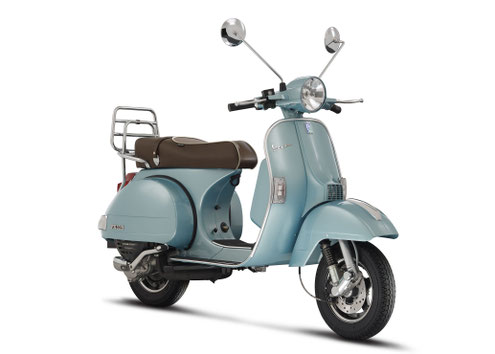 Vespa PX 125