
BSA 844 VICTOR Workshop Manual
- 7.4Mb
20 manuals
Surprisingly, the history of the BSA motorcycle brand began in the extremely distant 1692, namely, from the time of the reign of King William III. At that time, the British had to make arms purchases from the Netherlands, and on the initiative of William III, an agreement was signed with five Birmingham gunsmiths, and later the Birmingham Association of Small Arms Merchants was also organized, which was renamed Birmingham Small Arms Company in 1861.
Two years later, a small factory was established in Small Heath, on the basis of which BSA was founded. True, the first bicycles were produced only after 17 years. And in 1881, the company began its first independent project. For a long 12 years, attention was once again focused on weapons. Only in 1893 did the company return to the production of components for bicycles, and somewhat later for motorcycles. This went on for ten years.
In 1903, the actual assembly of motorcycles began on the basis of parts supplied by various companies. In particular, the supply of engines was undertaken by the Belgian company Minerva. Only in 1909 did the company create its own motorcycle. But all plans were disrupted by the outbreak of the First World War.
BSA was forced to switch back to military production. The weekly production of rifles reached 10,000 copies. Along with them, ambulances and staff cars were produced. The war ended, and for the umpteenth time the company switched production from “swords” to “screaming”. Two single-cylinder motorcycle models, designed before the war, went on sale. The production of V-engines, which were best suited for motorcycles with a sidecar, was also adjusted.
In 1921, BSA executives decided to try their production capacity in competitions, putting up the six best motorcycles for racing. But a terrible fiasco awaited the company. Not a single motorcycle reached the finish line - their pistons simply melted.
Work continued, and the forerunner of future success was the acquisition of Daimler. Excellent specialists came to the BSA, including design engineer Harold Briggs. He developed a small motorcycle with an engine capacity of 350 cubic centimeters, the maximum speed of which was up to 120 kilometers per hour. Its feature was the bottom valves.
Another engineer, Harry Poole, was involved in the Model B machine, nicknamed the "round tank." The Model B motorcycle was very popular in Germany. Over the entire existence of the brand, about 35,000 copies were sold. But the best BSA bike of those times was considered a motorcycle called Slouper. It was equipped with a slightly tilted forward engine of 500 cubic meters with a single top valve. It was first launched in 1927.
BSA motorcycles participated in various exhibitions. For example, the new A7 with an engine of 500 “cubes” was introduced in 1947 in Paris. And a year later, at the next show, viewers saw the conceptually new Bentem. It was a development of the DKW-RT125 project, it was equipped with a 125 cc engine and some other features, thanks to which it became the best-selling English motorcycle in history.
BSA-made bikes continued their performances at various competitions, such as the Isle of Man TT, ISDT and Golden Star, where they earned many awards and set a speed record of 120 kilometers per hour.
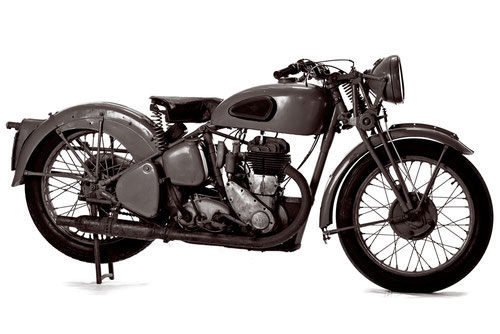 BSA M20